Winner Canada PIMs integrates all sampling and testing components, installed directly on the flue, different from the traditional extraction type detection system, PIMs, without the traditional sampling pipeline testing be extracted directly to the high temperature flue gas pool and emptying at the scene, form and function approximation In Situ detection (In - Situ Measurement), so called pseudo In Situ detection. PIMs technology ensures no distortion in flue gas sampling to the greatest extent, and avoids the problem that ammonia gas cannot be measured due to ABS (ammonium bisulphate) crystallization caused by traditional sampling pipeline.
Multiple PIMs are installed on the same flue, and multi-point simultaneous monitoring is realized through optical cable connection with R series multi-channel analyzer, which solves the problem of uneven distribution of ammonia escape.
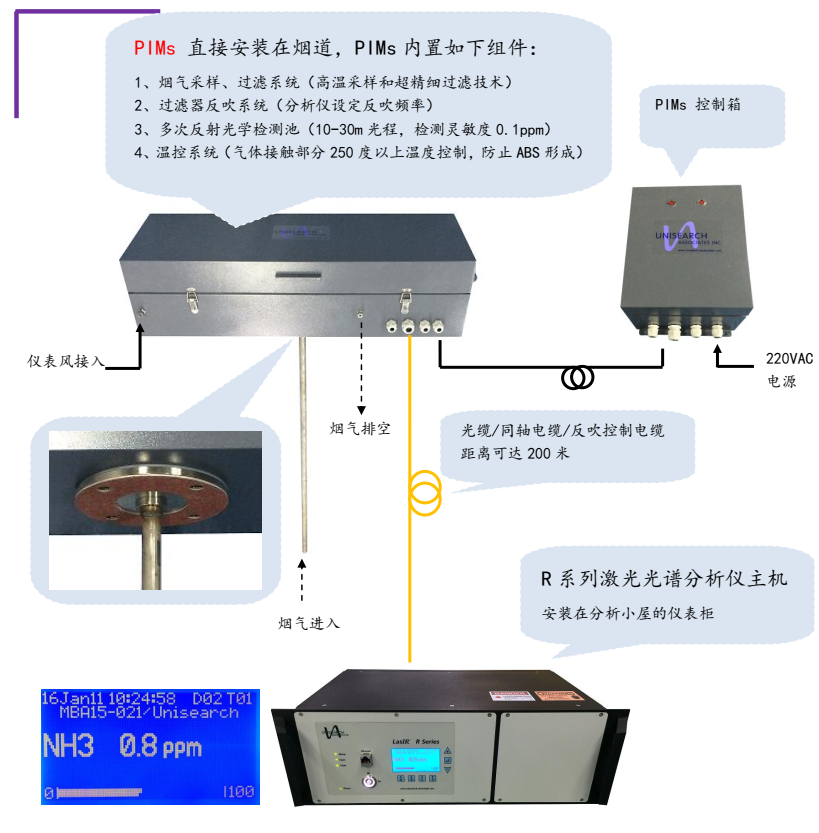
PIMs solves five major problems of ammonia escape monitoring in SCR/SNCR denitration process:
-The original flue gas and soot content of coal-fired power plants in China is up to 30-100g/m3, so the traditional convection type ammonia escape analyzer cannot penetrate such high soot, and the beam will be offset due to the change of boiler load, so the maintenance is large. PIMs completely solves the problem of too much soot and flue deformation.
-NH3+SO3+H20=NH4HSO4 (ABS), In SCR denitration gas, NH3 and SO3 will react to form ABS at a low temperature (the formation temperature is usually below 230 degrees, depending on the content of NH3 and SO3). The temperature of the sample tube of the traditional sampling pipeline extraction ammonia escape analyzer does not exceed 180 degrees, so ABS will be generated quickly in the sampling pipeline, resulting in partial or total loss of ammonia gas, and the test results are of no practical significance.
-In the SCR specification, ammonia escape must be controlled below 3ppm, but the sensitivity of traditional contrastive and ordinary extraction ammonia escape analysers is between 0.5 and 2ppm, which cannot meet the needs of ammonia escape detection at low concentration. The multiple reflection detection pool with 10-30m optical path is built into PIMs, which increases the detection sensitivity of ammonia escape by 10 times to 0.1 PPM.
-Ammonia escape in the flue gas is the same as SO2/NOx, and the distribution is not uniform. The traditional contrastive and ordinary extraction ammonia escape analysers cannot reflect the real ammonia escape distribution. The multi-channel R series analyzer connects several PIMs on the flue to realize simultaneous monitoring of ammonia escape in flue gas and provides real data for SCR optimization.
-For ordinary users, accurate low concentration standard ammonia gas is not easy to obtain, which brings great difficulties to the regular calibration of the site. The R series analyzer of Unisearch has built-in standard ammonia gas examination module and real-time calibration of the analyzer system.